Identity matters. Most people have their identity defined by the external world. They take it seriously. It’s life or death for them and there is no humour, honesty or even a playful attitude about such a topic. In this blog post I will discuss how I found my own pen/artistic name and how this identity has an affect on my art and life at large.
Foundations
In a previous post, (you can find below this section) I discuss how play and joy were the foundation of my art. Once I realised this, I discovered that what I was really looking for in my poetry was to take this idea further.
I wanted my art to represent a playground. I wanted my life to represent this too. Upon realising this, I discovered that we are constrained by identity and I certainly was. I was taking abstractions connected to my own identity too seriously and I knew that Jestora was my way out.
Purpose of My Poetry
Jestora represents a playground and a beautiful space where we can explore our creative energies, ideas, insights and intuitive insights. My mission is to bring poetry, ideas and energy to life and to create a playground where people can explore, play and be inspired.
My vision is a world where curiosity, play and creativity transforms everyday life into a living playground for everyone. To return briefly to the foundations, my values are:
Play
Curiosity
Creativity
Courage
Connection
I propose a different view to the poetry community. Whereas poetry is seen as a serious topic, I aim to make life playful, poetic and full of wonder. I am to use my art to create an experience you can feel, laugh with and step into.
Unlike traditional poetry or intellectual spaces, I create a living world and a playground for people to explore, play and be inspired.
This unique aspect is why the tagline for my brand is ‘off-script’.
Why my poetry will make the world a better place?
All religions discuss why the world is an illusion and something not to take too seriously, for good reason. It’s usually the most serious people who end up causing the most disaster and trauma to the world. The people who take their identity too seriously that they become fanatical.
Its their way or the high way and being so convinced, they assume (even logically) that the next step is for them to gain power and force others to follow them. People fight for land, nationalism and their interpretation of faith. In the name of the sacred they break the sacred.
It reminds me of a quote from the film the kingdom of heaven:
“Holiness is in right action, and courage on behalf of those who cannot defend themselves, and goodness. What God desires is here [points to head] and here [points to heart] and what you decide to do every day will make you a good man…or not.”
My poetry creates a space, a playground so that human beings can get away from the savage battlefield. Jestora from the words (Jest and Aura) is the man who does this. An identity, yes but one that anyone can become. One that I am now.
For those of you who are new to my blog page, my name is Muaad Sucule and I became a poet in my early twenties. This path eventually led me to find a lasting source of joy in my life. This is why I identify myself as a poet of joy. This joy is not something available only to people who write poetry.
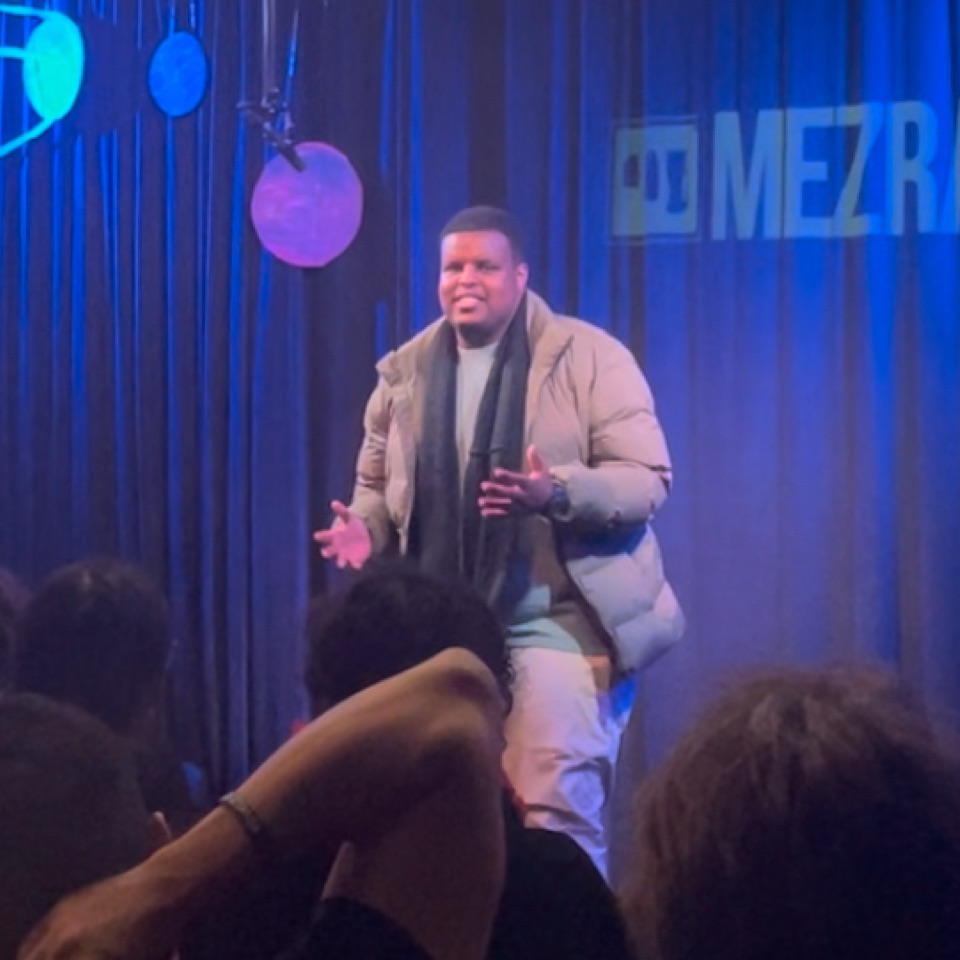
That’s me, Muaad Sucule, presenting a poem at Amsterdam’s House of Stories
It is available to everyone and my poetry is about sharing these insights with the whole world. Joy, in our world, is in three steps:
This was the process that I went through and when I look at others around me who are also happy, they have also been through a similar experience.
Follow @muaadverse on all social media platforms – Above is my logo
My journey didn’t start so well but like the soothsayer from Kung Fu Panda said: “Your story may not have such a happy beginning, but that does not make you who you are, it is the rest of it—who you choose to be,” is from the movie Kung Fu Panda 2. My story started with much difficulty. I was confused and I suffered from many difficult emotions.
At the same time, things were not going so well for me in my personal life and the world around. Eventually, you will give up and when you give up you realise that your ego (I.E. your image of yourself) couldn’t help you out of this situation and it couldn’t help you because it doesn’t exist.
You might be wondering, why is this a good thing? It’s because your image of yourself leads you to a type of psychological hell. It leads you to unnecessary conflict, internal frustration, close mindedness and causes you to make decisions that get rid of your peace.
Once this is out of the way, you begin to flow with the world around you. You begin to become more open minded, laugh more, have less internal frustration and the only conflicts in your life will be ones that are not caused by yourself.
You will become engaged with the world as you will see the world and understand that its a wave that you’re a part of and not a conflict that you’re struggling against. Then you will ride that wave into the future for the rest of your life.
This doesn’t mean you won’t have difficult or painful moments in your life but it does mean that you will always have the comfort of knowing that whatever pain you’re enduring – it will remind you of your real essence.
We can live lives that are joyful, meaningful, honest and bright. It is possible and that is what my poetry is all about.
A poem I always recite (written by me) is the following:
I am a flute,
Played by time,
My actions were never just my own,
Me and you are walking stories,
We are walking songs.
Enter Jestora
Jestora represents a multitude of things. It is an identity (persona and mask mean the same thing in Latin) that I created and one that represents both an ideal and a space. There is a deep reason why I adopted it as my pen and artistic name. Check out my upcoming blog about this identity of mine.
If you like my poems and my ideas – please follow @JestoraOfficial on all social media platforms including YouTube. Please show support and subscribe to this blog too!
“Like the masked guests of 18th century balls, we don’t always arrive with confidence; sometimes we wear it until it becomes our face.” – Muaad Sucule
Sometimes we wake up on a Monday and we aren’t motivated at all. Maybe we miss the weekend, maybe we are sick and tired of the grind and imagine a life where we were just born rich. Or maybe you’re not motivated because its November, the weather is not cool, you’re not seeing your friends as much and life is strange.
This is where the idea of ‘acting’ must come in. The truth is, you will be judged by people and even yourself on how you deal with moments in your life when you don’t have motivation. This where the ideas of mysticism, the trickster and the ego can all come together.
Acting until the you don’t have to any longer
Sometimes you have to act until the moment comes. Sometimes being alive feels like riding a powerful and happy wave and other times it feels like there is no wave at all. It all falls flat. In these moments, its good to remember that the word persona in Latin means mask.
When life feels overwhelming, its good to go into the mystical consciousness by zooming out and ‘riding the wave’ and when life feels flat, that is the perfect time to put on your persona and interact with the world and then you will find your rhythm again.
Conclusion
Find your motivation by playing the game of life when life feels flat and you don’t feel like going. Sometimes, healing also means putting on your mask and getting out there again until you are simulated.
If you like my content, please subscribe to my blog page and follow @muaadverse on all social media platforms!
By mysticism, I mean having an intuitive grasp of what life is truly about. I mean seeing, with suddenness, the facts that surround us. The word mysticism is a loaded word which I find unfortunate but I believe many people have an experience where they suddenly see things for what they are and not what they want them to be. They realise that they are connected to the outer world (not in the sense that they are one with it) but in the sense that they are a link in a chain that has existed thousands of years prior and will exists centuries after. This is a liberating feeling.
2. Practice
The path to mystical insight begins with the annihilation of the self. When the ego dissolves, one connects with the ultimate reality and naturally turns toward it in devotion. You taste the will of reality and rest content in it, like a flower fully opened to the sun.
This state emerges through deep contemplation of reality. True contemplation is not limited to formal meditation; it can unfold even as you work, as long as your attention penetrates the present moment. It is this sustained, mindful observation of life that awakens the mystical state.
Life’s difficulties naturally accelerate this process. Struggle erodes the ego, forcing humility and surrender. Those who face hardship with awareness often find themselves closer to the mystical experience than those untouched by challenge.
3. Experience
When one enters this state, the world reveals itself anew. Everything fascinates you, and you develop a profound desire to observe, understand, and worship the ultimate reality in all its manifestations.
This observation is peaceful and appreciative. You begin to love the world — not sentimentally, but because all creation is part of what shaped you. You recognize the sacredness of the Now, the eternal presence in which all things exist.
4. Philosophical Considerations
Can mystical knowledge be trusted?
Yes. Mystical insight is a valid form of understanding the human experience. It is not merely subjective; across cultures and ages, mystics have documented remarkably consistent experiences. The creative mystic, having transcended rigid identity, is often less prone to bias when observing others.
Furthermore, having such an experience makes you more creative. You are able to think outside the box, reflect deeply, contemplate deeply, analyse details longer and negate your ego so you can be a better imaginative mind. Such an experience heightens your attitude, increases your enthusiasm and drive thereby making you a better student.
Relationship to reason:
Reason is part of creation — it belongs to the mind and the intellect. Mystical insight does not compete with reason; it transcends yet complements it. One does not need to measure mystical knowledge against intellect, as they operate on different planes. The mystical insight improves reason the way a healthy body improves a healthy mind.
The ego problem:
The ego is not an enemy. It is part of who we are, and through mystical experience, it naturally transforms. There is no need to exaggerate or resist this process; it unfolds as life itself unfolds. Having positive pride in yourself is good, it is arrogance which is bad. Having confidence and excitement is good it is thinking you know everything, being fanatical and narrow minded which is wrong.
Universality:
All mystics touch the same ultimate reality. Some lose themselves in conceptual frameworks, sectarian views, or struggles to explain what they experience. Yet beneath all differences lies the same direct encounter with the source of existence. The mystical experience is like the body, so the minds of the mystics throughout time are different and therefore they would explain this experience differently.
5. Conclusion
Mysticism is a journey of direct encounter, deep contemplation, self-surrender, and worship of the ultimate reality. Life’s difficulties, far from being obstacles, are teachers that erode the ego and bring us closer to the divine source. Through awareness, observation, and appreciation of the present, one discovers a world filled with fascination, love, truth, and devotion.
To be a mystic is not to escape life, but to see life in its fullness — to open like a flower, entirely to the light of reality, and see with true rationality, the full facts that surround us.
There was a moment that changed everything for me. I was moved by Rumi’s poetry, and in that instant I realized that poetry has the power to move us in ways nothing else can. Words on a page could touch the heart, lift the spirit, and open a door to meaning. That was the spark that set me on the path I walk now.
Before poetry entered my life, the world felt lonely and cold. I looked out and saw life as a war, a series of conflicts to survive. Every day felt like a battle, and even the quiet moments were heavy with the sense that something was missing. There was no colour in the way I experienced the world, only shades of gray.
When I began to write, the challenges came quickly. The first was vulnerability. As a man, I felt the weight of showing my emotions in front of others, of standing on a stage and opening my heart with confidence. It felt like walking unarmoured into a battlefield. Yet, I learned to embrace that vulnerability, to see it as strength rather than weakness. The second challenge was finding my voice. For years, I searched, unsure of what kind of poet I was meant to be. But eventually, after persistence and self-discovery, I found my voice. Once I did, it was as if the words finally belonged to me.
Over time, I learned that poetry is not a struggle between intuition and intellect, heart and mind. It is a process, a dance between the two. I listen to my heart and intuition, for they tell me how I feel about my experience in the world. Then I turn to my intellect and mind, using them to craft these feelings into powerful, well-formed art. The two are not enemies. They are partners, and when they work together, they create something genius.
Through poetry, I have become more than what I was. I learned lessons about media and communication theories, about presenting, writing, and design. I discovered skills I never knew I had, and more than that, I began to see the world differently. What was once colorless has now come alive. The world is no longer daunting; it is alive with possibilities, alive with stories, alive with meaning. Even when I face difficult emotions, I know I can transform them into verse, shaping them into something beautiful.
This is what I hope my readers carry with them after encountering my poems. Whether it is the creative form I chose, the ideas I explored, or the emotions and experiences I tried to capture, I want my words to stay with them. I want them to leave my poetry with something they did not have before, something that lingers and shapes the way they see the world.
Conclusion
I began as a poet of the heart, giving voice to emotion. Then I became a thinking poet, marveling at the mind’s many powers, its ability to reason, discern, imagine, judge, plan, and create. I came to see the intellect as a divine gift, capable of ordering the turbulent inner world and guiding action in reality.
Yet the mind alone is like a faithful servant locked in a specific arena, confined to its own domain. Only the prophetic light that touches the heart acts as the key, unlocking the cage, allowing the intellect to grow wings, and lifting it to a higher level where knowledge becomes clarity, insight becomes guidance, and understanding becomes life itself.
My poetry now stands at this meeting point, the disciplined mind touched by the heart of light, where thought is elevated, vision expanded, and the soul guided. Reason is awakened and set free, rising beyond its former limits. This is a new chapter.
If you want to see my poems check out @muaadspoetry on Instagram please! 🙏🏽
Many people assume that mystical experience exists in tension with reason or that the ego is an obstacle to connecting with ultimate reality. From my experience, this is not the case. Mysticism, reason, and the ego are not enemies — they are different channels through which the same reality can be understood and expressed.
1. Mystical Insight as Direct Experience
At its core, the mystical experience is about connecting with the ultimate reality — the truth that underlies all existence. When the self is temporarily dissolved, when the ego loosens its grip, we become like a flower fully opened: receptive, aware, and at peace. This is not merely a mental exercise; it is a lived experience of reality itself. In these states, we perceive life clearly, with awe and love for the world around us.
2. Reason as a Part of Creation
Reason is a tool, a part of the created world, and a reflection of the soul’s intellect. It is not opposed to mystical insight — it complements it. While mystical experience reveals the immediacy of existence, reason allows us to understand, articulate, and navigate the patterns we observe. Far from clashing, reason can deepen mystical understanding by helping us process insights and share them in meaningful ways.
3. The Ego and Its Natural Transformation
The ego is often misunderstood as a barrier, but it is simply a part of our human identity. Mystical experience does not destroy the ego violently; it transforms it naturally. Life’s struggles, joys, and challenges erode the ego’s rigidity, preparing the mind for deeper insight. In fact, those who struggle most intensely are often closest to mystical realization because difficulty dissolves the false sense of self, leaving a purer vessel for connection with ultimate reality.
4. Universality of the Experience
All mystics touch the same underlying reality, even if their interpretations differ. Some get caught in abstract reasoning, others in ego-driven concerns or rigid doctrines. Yet the essential truth remains: mystical insight, reason, and ego are all threads in the same tapestry. Understanding this allows us to see life with clarity, compassion, and awe.
5. Living the Integration
In practice, embracing this integration means living thoughtfully while remaining open. We reason to navigate the world and make sense of experience. We honor the ego as a necessary guide. And we cultivate mystical awareness through contemplation, meditation, and openness to life’s unfolding. Together, they create a holistic approach to being — one that is simultaneously rational, grounded, and deeply connected to the divine presence in all things.
Mysticism is not a rejection of intellect or identity; it is the fullest expression of both. When we see reason and ego not as adversaries but as allies in the journey, we realize there is no true clash — only harmony waiting to be experienced.
Conclusion
A famous philosopher once said that “mysticism is the recognition of the pure fact,” because “the pure fact is mystery.” Thats why I believe that mystical experience isn’t anti-rationalism. It’s an experience where an individual accepts the world as it is.
With an open spirit and see things in a different lens. It’s the mark of a unique and enlightened mind that has been illuminated. Such a person is naturally at peace and is a positive force in the world. The mystical vision becomes a way of seeing patterns and higher order. The mystic is then the ultimate thinker.
The path of love is very interesting and as of yet it seems to be the most influential thought on my poetry. I first began my journey at the period when I began connecting with poetry when I listened to some of Rumi’s poems. Back then, however, I didn’t understand what he meant by love.
I remember listening to a line where he said ‘love is the astrolabe of Gods mysteries’ and immediately I thought what you’re probably thinking now, what on earth is an astrolabe? What is this way that he is describing love? What is love according to Rumi. Hence began a 2 year journey studying this concept.
A few years and a bunch of books, lectures and correspondence with Rumi experts like Dr Omid Safi later, I discovered that Rumi (and the Islamic Sufi scholarly tradition which has built up in the persian speaking world) views love as an attribute of God. A cosmic force that is spread out in the world and the aim of these people was to connect with this force that acts as a transformative purifying process in peoples lives.
Its a force that connects you with God, helps you establish justice on the earth and a force that ‘leads people home’ as Dr Omid Safi would say. A force that takes you back to God. I was struck by this unique but popular tradition which I had absolutely no idea about coming from the UK from a Somali background.
It was only during my time in the Netherlands, where I met so many different communities across the world where I stumbled across this well thought out tradition. I had a game-mentality towards the world. My mind was influenced by materialism and (until now in the UK) I noticed that people in the western world, particularly the UK, judge themselves based on their outward external successes. This was all set to change because of the mystics.
My Thoughts
This tradition has certainly shifted my perspective and the way that I look at the world around me. I’m still new to studying the works of the Islamic mystical poets but it is certainly very interesting. I had what I would describe as a mystical experience. I felt this feeling, the best way to describe it would be to say that in one moment I felt the total harmony of my life with the world around me.
Emotionally I felt like my heart was opening up and this was helped by the beauty of the Netherlands and having a side job as a delivery driver in a country where you could bike around on designated bike lanes and enjoy the view of the nature. I had this incredible appreciation for life and my intuitive powers were heightened. These feelings have remained.
Thereafter I turned inwards and after a few years I discovered who I was although for a long time the inward journey was painful. After sometime I understood myself, why I did previous actions, what led me here and how I began to forgive myself as well for my mistakes.
The path of love, as explained by the Persian mystics was appealing because they spoke of such experiences which I was undergoing. They discussed the realities of the world and they stressed the importance of loving other human beings. At this period I first came across humanism as well.
This had a profound effect on the way I viewed power structures in society. In the way I viewed people and power. I realized that I needed to become more human which was what the mystics said but it was something I was unaware of. There is so much dehumanizing going on around the world and it was something I was used to.
I even dehumanized myself. There was a period where I thought (and many young men must think the same) that my worth came from my results. That I had to be perfectly strong and successful for my parents, siblings, friends and the community. There was no room for vulnerability of weakness. Its no wonder why I ended up getting burnt out when I was younger.
For a while I rejected this thought. I would say for two reasons, one because it was unlike anything I have ever read before so it challenged my paradigm and two because I believed that in life I must be strategic and rational. Once I realized that these poets displayed intellectual sophistication and were extremely creative I realized that I couldn’t put them in a wrong box.
They were intellectual poets and thought leaders. The world would be a better place if it is led by love. The best leaders are leaders who are compassionate and justice in society is the most loving thing someone could do. The military generals/politicians I had read about until then were ruthless and disconnected from their human side.
I agreed with them from a intellectual level. As a poet I admired the beauty they created in their verses and it touched me. They displayed knowledge, precision, skill and sophistication. I ended up looking up to them. Unity, spirituality, justice, mercy were all things the world needed.
So after realizing I was on board from an intellectual level I thought about how I felt regarding them. Deep down, my intuition felt positively about them. Now intuition is complex but for a million different reasons I knew why they were correct and my intuition calculated it quickly and that’s why I was so drawn to them. From an emotional angle, I was connected with them as the beautiful verses of love rippled through my heart.
From a strategic angle, being a poet of love is also the ‘right chess move’ in the external world. We are all sick and tired of egos, individualism and this society that worships the self. We are tired of the unsophisticated debates that we see on TikTok about gender and race. The people want to see beauty, compassion and love emanating or coming in the form of a poet. I know this in my bones. So as a poet, the path of love is the path to take.
To connect with people, organizations and the world from this clear paradise. This strategic heaven where the world makes sense, where my thoughts are clear and where my intuitive powers are active. Thank you for reading this blog post.
For a long time I carried the burden of other people’s opinions. I thought poets must have opinions on issues that are going around in the world. This was because, as a child, I would see adults discuss this topic over and over with such seriousness and I thought every person must think about political events, stay informed and have an opinion.
This all changed slowly. Over time I realised that I was uncomfortable presenting poems. This year (a deleted post) I presented for a radical organisation at a certain university regarding a certain political event that was taking part in the world.
I felt uncomfrtable during the entire process and the after process and the discomfort remained with me for many months. I realised that I need to study where this is coming from. I presented a poem for a country and I realised three things:
I was being used as a pawn by members who were pushing a political agenda as my message for peace was a message that no one wanted to hear.
The organisation I was representing didn’t actually want to build bridges but were more interested in pushing their opinions out.
I felt uncomfortable because many people who were partisan were quite sectarian and perhaps even hateful. The line could get blurred from time to time in that realm of thinking.
There was a deeper reason why I was uncomfortable and that was the reason. Sometimes you have to do something to realise what you don’t want to do. I realised that I wanted to transcend politics and make an impact where I discuss ideals and values rather than events and what the correct position is. I thought about poets that I admired like Rumi or Marley and I wanted to follow them in the way that they try to transcend binary politics to discover the truth.
The truth was what concerned me, my image too. I didn’t want to be viewed as a partisan, black and white opinionated person because I am not that person. I decided never to write a political poem again and never to take sides and be used as a pawn to present poems where I indirectly push agendas that I might not even be aware of.
What is apolitical? Does it have depth?
Far from being a lazy position, apolitical artists take a deliberate decision to avoid polarisation, partisan bias, political stress, propaganda, hostility & identity politics.They do this to transcend politics and focus on art and promoting positive ideas that are beneficial to humanity like unity, love, beauty and wisdom.
If every artist with a platform, large or small, constantly gets involved in politics then where will the people find a break from the day to day chains of reality?Who can the people trust to listen to about important universal messages? How can someone call themselves a poet of love if they are partial with their message of love and compassion?
It’s alright if others disagree but this has been something I’ve wanted to do for a while and something that has sat with me intellectually and spiritually for a long time now.I want to be far sighted and transcend opinions to focus on discussing messages related to ideals and values. This is why my brand will remain apolitical going forward.
Notable Apolitical Poets Throughout History
In both medieval and ancient times, poetry often intertwined with religion, philosophy, and myth, but some poets remained detached from the political dynamics of their day, focusing on more spiritual, artistic, or philosophical concerns. Here are a few from both Eastern and Western traditions during those periods:
Medieval Poets (East and West)
1. Li Bai (701–762) – China
Style/Themes: A renowned Tang dynasty poet, Li Bai was known for his nature poetry, wine-inspired musings, and reflections on the human condition. Although he lived during a politically tumultuous time, his works often stayed away from direct political commentary, focusing more on personal freedom, nature, and existential thoughts.
Notable Works: Drinking Alone by Moonlight, Quiet Night Thought
Style/Themes: Rumi’s poetry is deeply mystical, focusing on themes of love, unity with the divine, and spiritual transcendence. He did not involve himself in political matters, instead dedicating his life and poetry to exploring the relationship between the human soul and the divine.
Notable Works: Masnavi, Divan-e Shams-e Tabrizi
3. Dante Alighieri (1265–1321) – Italy
Style/Themes: While Dante is remembered for his Divine Comedy, which does contain references to politics, his larger focus was on the soul’s journey toward God, the structure of the cosmos, and human morality. Much of his poetic output can be considered apolitical in the sense that it focused on the individual’s spiritual journey rather than political activism.
Notable Works: Divine Comedy, La Vita Nuova
4. Mīrābāī (c. 1498–1547) – India
Style/Themes: A 16th-century poet-saint from Rajasthan, Mirabai composed devotional poetry to Krishna. She distanced herself from the politics of her royal upbringing, instead devoting her life and poetry to spiritual love, the worship of God, and renunciation of worldly affairs.
Notable Works: Poems of Devotion to Krishna (various bhajans)
Ancient Poets (East and West)
1. Sappho (c. 630–570 BCE) – Ancient Greece
Style/Themes: Sappho’s poetry centers on personal emotions, love, and relationships, often with a focus on passion and the inner life. Though she lived in a politically complex period, her poetry remains mostly apolitical, dealing with intimate, personal themes.
Notable Works: Most of her poems survive only in fragments, but her lyrical poetry is celebrated for its emotional depth.
2. Bashō (1644–1694) – Japan
Style/Themes: A master of the haiku, Bashō’s poetry often centered on nature, simplicity, and spiritual reflection. He lived during the Edo period but remained detached from political movements, focusing instead on Zen-inspired meditations on life and nature.
Notable Works: The Narrow Road to the Deep North (a travelogue of poems)
3. Horace (65–8 BCE) – Ancient Rome
Style/Themes: Although Horace held positions under the Roman Empire, much of his poetry is apolitical and focuses on the philosophy of life, the pursuit of contentment, friendship, and the fleeting nature of human existence. His Odes are philosophical and often focus on personal and reflective themes.
Notable Works: Odes, Satires
4. The Bhagavad Gita (5th–2nd century BCE) – India
Style/Themes: While technically part of the Mahabharata, the Bhagavad Gita is a philosophical and spiritual text that uses dialogue between Prince Arjuna and the god Krishna to explore the nature of duty, ethics, and the soul. Although situated within a political conflict (the Kurukshetra war), the poem transcends the political and delves into metaphysical and ethical questions.
Notable Works: The Bhagavad Gita (as part of Mahabharata)
5. Omar Khayyam (1048–1131) – Persia
Style/Themes: Known for his Rubaiyat, Khayyam’s poetry often reflects on life’s fleeting nature, the joys of wine, and the mystery of existence. He lived through the political tensions of the Seljuk Empire but remained detached, focusing instead on existential musings and the pleasures of life.
Notable Works: Rubaiyat of Omar Khayyam
These poets, both in the East and the West, often engaged with deeper spiritual, philosophical, or personal matters, leaving the political landscape mostly in the background. Their works reflect a focus on nature, love, existence, and the divine rather than political activism or commentary.
Conclusion
When I read these poets I have a good feeling about them and I want to become like them. Taking a position that is apolitical feels very good to me. It feels right, it allows me to take my time, think things through. It does give me a privelige and in an unpriveleged world I need that. It gives me the privelige of waiting, researching and observing what is happening without comitting myself to a view.
It gives me the option to step back and not commit myself to a view. I feel like if I did that before in my life I wouldn’t have got involved in debates, I wouldn’t have lost friends and I would have way less stress. The truth is, shakespeares works show us that there’s alot of actors in politics that are complex, unpredictable and mysterious. The current world reflects this. I don’t know who those actors are and I don’t know what they are doing now and I don’t know if I want to support them. This is the wisest approach for me.
We live in a dual world. There are so many opportunities, yet so much misery across the globe. There’s so much to be grateful for, and at the same time, so much to be sad about. Somehow, everything feels like it’s changing, and the past seemed easier.
This is a dual world. There has been so much improvement in our personal journeys, yet there is still such a long way to go. We often feel invisible, yet there is so much connectivity through social media. We have gained so much knowledge about history and oppression, yet there is still so much division.
We live in a time of great technological advancement, yet there is an increasing sense of disconnection from reality. Our lives are more convenient than ever, yet we struggle with anxiety and depression at unprecedented levels. We have access to endless information, yet it often leaves us feeling more confused than informed. There is a surge in self-expression, yet many feel more misunderstood and isolated.
We have become more environmentally conscious, yet our consumption habits are driving us closer to ecological disaster. We demand transparency from those in power, yet misinformation spreads faster than ever before. There is a growing recognition of mental health, yet stigma and barriers to care persist. We cherish individuality, yet often conform to societal expectations. We celebrate diversity, yet prejudice and discrimination still thrive.
There is so much glorification of romance, yet so many gender wars. There are so many more educated people, yet so many more arguments. There are so many calls for peace, yet so much war in the world. There is so much awareness of our identity, yet so many feelings of not belonging. There is so much talk of religion, yet so few spiritual people. There is so much focus on “me and you,” yet so little on “us.”
There are so many more jobs, yet it is so difficult to acquire wealth. There is so much more discussion about emotional intelligence, yet so much more silent heartbreak. I’m tired of all this duality; I’m tired of this period. I think we secretly wish to be younger, not because of youth, but because we were blissfully unaware of this harsh, relentless world.
Stuck and in a slump. That’s how I found myself for the few months before I was able to overcome writers block. What is writers block? Its usually only ever seen as a period where you have run out of ideas or when writers are empty. Often times writers take forever to return or worse, spend their time writing things which aren’t authentic.
I had writers block after I completed my internship. At the time I was figuiring out how I would market my brand but my actual writing slowed down. It wasn’t that I wasn’t publishing poems (I was) it was just that it wasn’t at the speed and rate that I was doing it previously.
My life as a poet slowed down. I was writing less and I wasn’t living as a poet. I was troubled by what was going on in the world and my mind began to process what happened to me in the past. For some reason I spent a lot of time listening to my ego.
I was more interested in external events in the world rather than on how I felt inside. That stopped me from writing. These processes were happening within me too quickly and I stayed like this for many many months. Perhaps 5 months. Or more.
Eventually I missed my old life as a poet. My life from last year. I realised that a writers block was precisely that, a block but an internal block. I realised that the reason why it happened was because I finally hit a crossroad. An internal crossroad. Was I willing to change based on all the lessons I learnt, the experiences I had (as an international student studying abroad) the poetry I read or was I going to try and remain nostalgic by clinging onto who I was in the past.
I decided to change. I looked within and realised that I felt peace and calm.I was no longer broken, angry, confused or sad. I was wiser. I had just turned 24 and I felt like a man. I understood the world around me – at least a heck of a lot better than I did at 18.
I looked within and I saw that I most wanted was to love myself now. You can’t love others if you can’t love yourself and you certainly can’t love and change the world. I was confused with my own thought patterns. I wanted love and yet I wasn’t giving myself permission to love myself. Strange.
After I did that I purchased things I’ve liked since I was a kid like new hats, bottles and beach sandles. Somehow, I understood the mystical poetry of the poets I read a year prior. I understood that poetry is when the soul is dancing. Poets were dancers in their own way. Soul dancers.
This time when I read them, I understood each line. I was no longer rushing through lines I slowed down and nejoyed each word. I was moving camly and slowy. At night, my own soul began dancing and I began outpouring my words.
I had gotten over my writers block. I was a poet once again. This time, changed forever.





 Jestora